

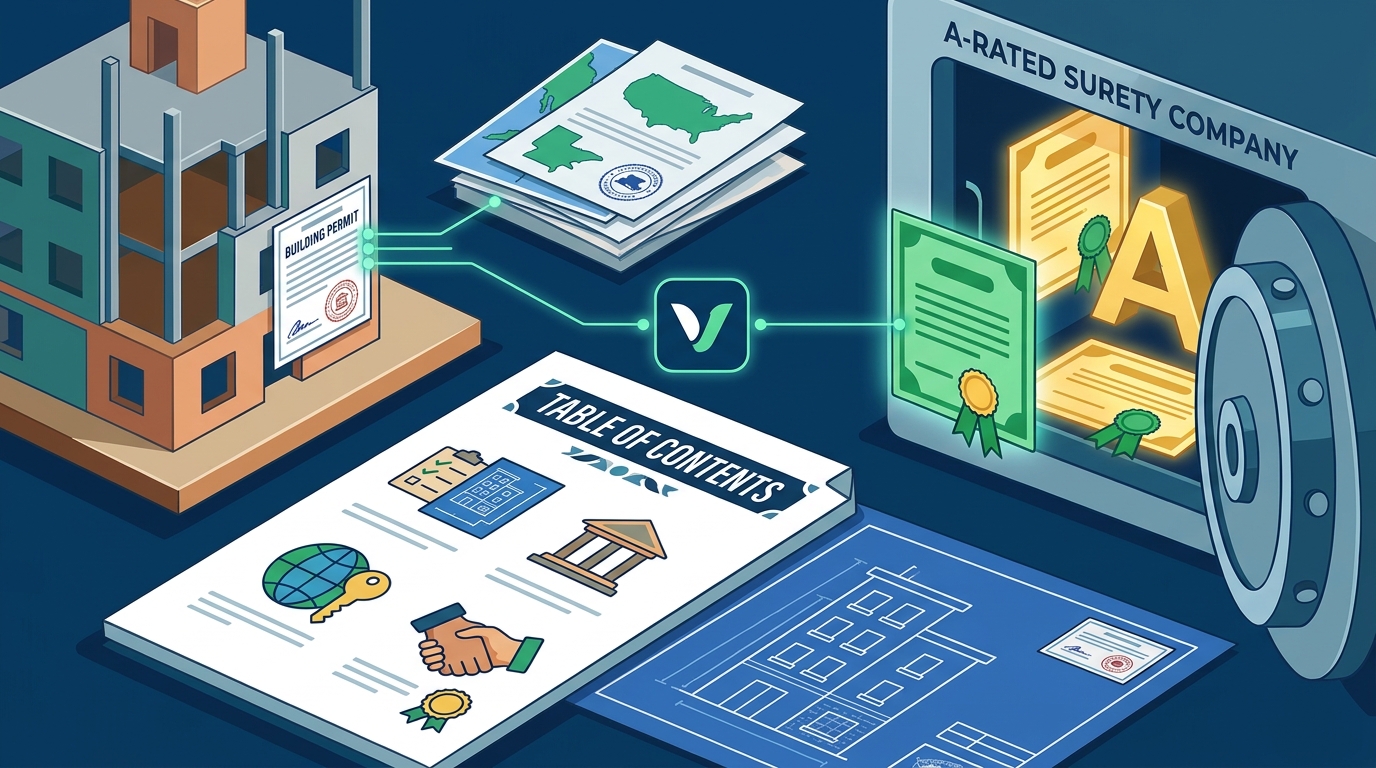
Permit bonds are issued by A-rated surety companies that guarantee a contractor will comply with local building codes and permit conditions. This guide covers the major surety issuers, the jurisdictional licensing rules that dictate bond requirements, and how online platforms like BLDAssure streamline the issuance process for contractors and property owners.
Surety Bond Issuers
A surety bond is a three-party contract between a principal (the contractor), an obligee (the government or property owner), and a surety (the insurance company). The surety company issues the bond and assumes financial responsibility if the principal fails to meet the bond's conditions. For building permits, the bond typically guarantees that the work will be completed according to the approved plans and local codes.
Major National Surety Companies
Most permit bonds are issued by large, A-rated surety carriers. These companies have the financial strength to back millions of dollars in bonds across the country. Common issuers include: according to Permitting Snohomish County
- Travelers: One of the largest surety providers in the U.S., offering a wide range of construction and commercial bonds.
- Chubb: Known for its strong underwriting capabilities and global reach, Chubb issues bonds for contractors of all sizes.
- Liberty Mutual: Provides surety products that are often integrated with general liability and workers' compensation policies.
- USAA: Offers surety bonds primarily to its members, including many small to mid-sized contractors.
- Propeller: A digital-first surety partner that BLDAssure integrates with to provide instant bond issuance for many permit and license requirements.
These companies do not just issue bonds; they underwrite the risk. This means they review the contractor's financial health, credit score, and loss history before approving the bond. A strong financial profile can lead to lower premiums and higher bond limits.
The Role of the Surety in Permit Compliance
When a contractor pulls a building permit, the local jurisdiction may require a permit bond. The surety company's role is to protect the public and the property owner. If the contractor abandons the project or violates building codes, the obligee can make a claim against the bond. The surety then investigates the claim and may pay out up to the bond amount. This protection is why jurisdictions require these bonds: it ensures that the work is completed safely and legally.
Jurisdictional Licensing Requirements
Permit bond requirements are not uniform across the country. They are set by local jurisdictions, including cities, counties, and states. This means that the bond amount, type, and even the requirement itself can vary significantly from one neighborhood to the next. Understanding these jurisdictional differences is critical for contractors who operate in multiple areas.
State vs. Local Authority
In some states, the state licensing board sets the bond requirements for all contractors within the state. For example, in California, the Contractors State License Board (CSLB) requires a $25,000 contractor license bond for all active contractors. However, local jurisdictions can impose additional permit-specific bonds. In other states, like Colorado, there is no statewide general contractor license bond, but cities like Colorado Springs may require specific bonds for certain types of work, such as concrete or sidewalk repairs.
Common Permit Bond Scenarios
Permit bonds are often required for work that affects public rights-of-way or requires significant public investment. Common scenarios include:
- Right-of-Way Work: Excavation, utility installation, or sidewalk repairs in public streets often require a bond to guarantee restoration of the public property.
- Grading and Earthwork: Large-scale grading projects may require a bond to ensure erosion control and final grading are completed as approved.
- Subdivision Improvements: Developers may need to post a bond to guarantee that streets, sidewalks, and utilities will be built before the final plat is recorded.
BLDAssure helps contractors navigate these complex requirements by compiling license, bond, and permit data from public records. This allows contractors to see exactly what is required for a specific project in a specific location, reducing the risk of non-compliance.
Online Bond Issuance
Traditionally, obtaining a surety bond required meeting with a local insurance agent, filling out paper applications, and waiting days or weeks for underwriting. Today, online platforms have transformed this process. Digital issuance allows contractors to apply for bonds in minutes, with many bonds under $25,000 issued instantly.
How Digital Underwriting Works
Online platforms use automated underwriting to assess risk. This involves pulling the contractor's public license records, checking credit scores, and reviewing loss history. If the contractor meets the underwriter's criteria, the bond is issued instantly. This speed is crucial for contractors who need to pull a permit on a tight deadline. BLDAssure integrates with Propeller Bonds to provide this instant issuance for many permit and license bonds.
Benefits of Online Issuance
Online bond issuance offers several key benefits for contractors and property owners:
- Speed: Bonds can be issued in seconds, allowing contractors to pull permits immediately.
- Transparency: Contractors can see the bond status, expiration date, and premium in one place.
- Integration: Digital platforms can link the bond to the specific permit and project, creating a single source of truth for compliance.
For property owners, online platforms like BLDAssure provide visibility into whether a contractor has the required bonds on file. This reduces the risk of hiring an unlicensed or unbonded contractor, protecting the owner's investment.
Key Takeaways
- Permit bonds are issued by A-rated surety companies like Travelers, Chubb, and Propeller.
- Bond requirements vary by jurisdiction, with local cities and counties often setting specific rules.
- Online platforms enable instant bond issuance, reducing wait times from weeks to seconds.
- BLDAssure integrates with Propeller to provide digital bond issuance and compliance tracking.
- Contractors should verify bond requirements for each specific project and location.
- Property owners can use contractor data platforms to verify bond status before hiring.
- Digital underwriting uses public records and credit checks to assess risk quickly.
- Permit bonds protect the public and property owners by guaranteeing code compliance.
Frequently Asked Questions
Who issues permit bonds for building permits?
Permit bonds are issued by A-rated surety insurance companies. These companies underwrite the risk and guarantee that the contractor will comply with local building codes and permit conditions.
Do all jurisdictions require permit bonds?
No, permit bond requirements vary by jurisdiction. Some cities and counties require bonds for specific types of work, such as right-of-way excavation or grading, while others do not. Contractors should check with their local building department for specific requirements.
How much does a permit bond cost?
The cost of a permit bond depends on the bond amount, the contractor's credit score, and the surety company. Premiums are typically a percentage of the bond amount, ranging from 1% to 5% for most contractors.
Can I get a permit bond online?
Yes, many permit bonds can be issued online through digital platforms. These platforms use automated underwriting to issue bonds instantly, often within seconds of application.
What happens if a contractor violates the permit bond?
If a contractor violates the terms of the permit bond, the obligee (usually the local jurisdiction) can make a claim against the bond. The surety company will investigate the claim and may pay out up to the bond amount to cover the costs of correcting the violation.
How does BLDAssure help with permit bonds?
BLDAssure integrates with Propeller Bonds to provide instant online issuance of permit and license bonds. The platform also compiles license and permit data from public records, helping contractors and property owners verify compliance.
Are permit bonds the same as license bonds?
No, they are different. A license bond guarantees that a contractor will comply with state licensing laws, while a permit bond guarantees compliance with specific local permit conditions. A contractor may need both, depending on the jurisdiction and the project.
Conclusion
Understanding who issues permit bonds and how to obtain them is essential for contractors and property owners in the construction industry. By working with A-rated surety companies and leveraging digital platforms like BLDAssure, you can streamline the bonding process and ensure compliance with local jurisdictional requirements. To explore how BLDAssure can help you manage your permit bonds and contractor data, visit our surety bonds page. according to Permits and Handouts