

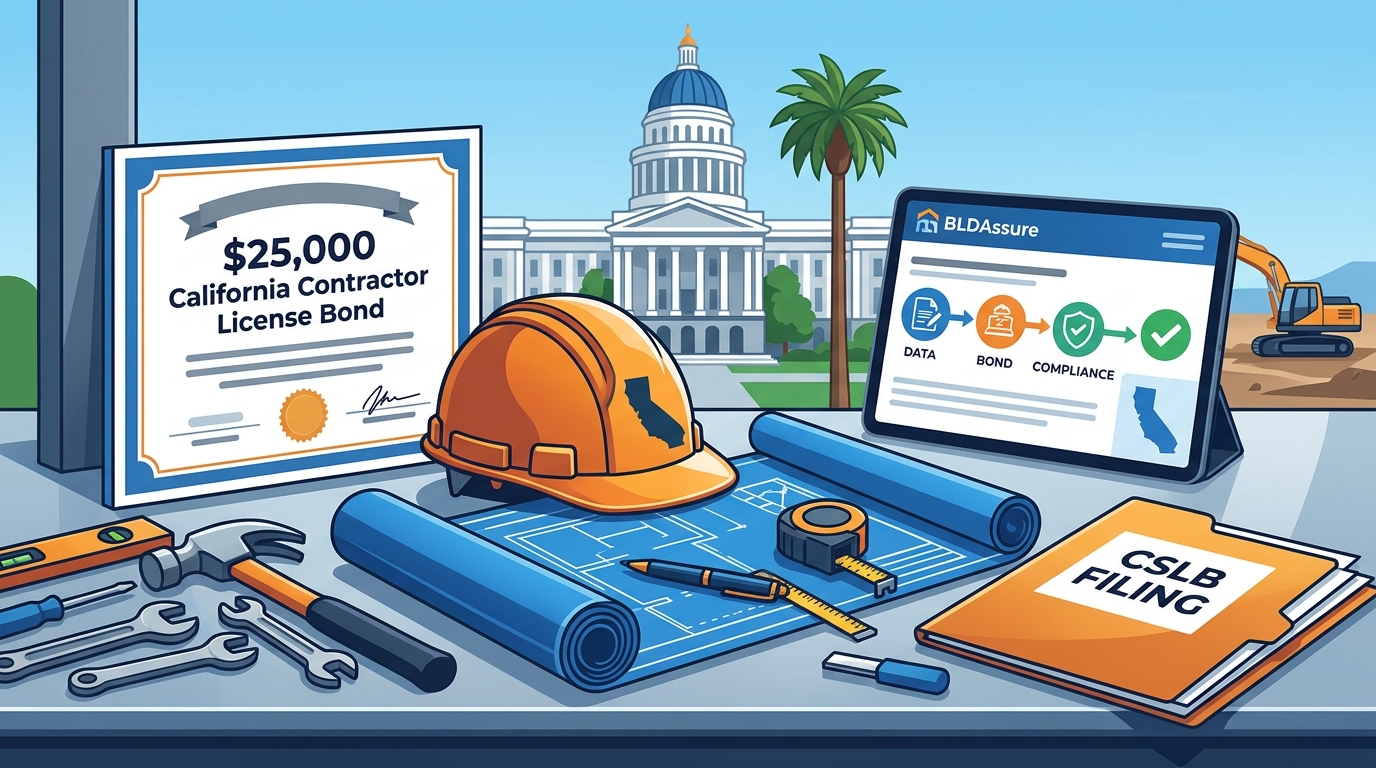
Contractors in California can obtain the required $25,000 license bond through licensed surety providers, including digital platforms like BLDAssure that partner with A-rated sureties. This guide explains the legal requirements for the California contractor license bond, how to file it with the Contractors State License Board (CSLB), and how to choose a provider that streamlines the process for your specific trade and business structure.
Surety Bond Providers
Choosing the right provider is the first step in securing your license. A surety bond is a three-party agreement between the principal (the contractor), the obligee (the state or CSLB), and the surety (the insurance company). In California, the bond amount is fixed at $25,000 for all contractor license classifications, a requirement established under Business and Professions Code Section 7071.6. While the amount is standard, the cost to obtain the bond varies based on your credit score, business history, and the specific surety company you choose.
Traditional vs. Digital Surety Partners
Factors Influencing Bond Pricing
| Provider Type | Typical Turnaround | Application Method | Best For |
|---|---|---|---|
| Digital Platform (e.g., BLDAssure) | Instant to 24 hours | Online, automated | Speed, convenience, and transparent pricing |
| Traditional Broker | 3 to 10 business days | Phone, email, or in-person | Complex risk profiles or multi-state licensing |
| Direct Surety Carrier | 5 to 15 business days | Direct application to insurer | Large enterprises with established relationships |
CSLB Filing Requirements
Once you have secured the bond, you must file it with the Contractors State License Board (CSLB). The bond is a legal requirement for every active California contractor license. If you are applying for a new license, the bond must be on file before the CSLB will issue your license. If you are renewing an existing license, the bond must be renewed or maintained in active status to keep your license active. Failure to maintain the bond can result in the suspension of your license, preventing you from legally bidding on or performing construction work in the state.
Who Must File the Bond?
All contractors holding a California license, including general contractors and specialty contractors, must maintain a $25,000 bond. This applies to both individual license holders and corporate entities. For corporate licenses, the bond is typically filed in the name of the corporation. The CSLB requires that the bond be issued by a surety company authorized to do business in California. The bond protects the public by providing a financial recourse if a contractor fails to comply with state laws or regulations. Homeowners and workers can file claims against the bond if they suffer financial loss due to the contractor's violation of the law.
The Filing Process and Verification
When you purchase a bond through a provider like BLDAssure, the provider typically handles the electronic filing with the CSLB on your behalf. You will receive a certificate of the bond, which you should keep for your records. The CSLB updates its database to reflect the active bond status. You can verify your bond status at any time by checking your license record on the CSLB website. It is important to note that the bond is separate from your insurance policies, such as general liability or workers' compensation. While insurance protects you from third-party claims, the bond protects the state and the public from your non-compliance. BLDAssure allows contractors to manage both their bonds and their insurance certificates in one place, ensuring that all compliance documents are current and easily accessible when requested by clients or the CSLB.
Key Takeaways
- The California contractor license bond is a mandatory $25,000 surety bond required by the CSLB for all active licenses.
- BLDAssure partners with A-rated sureties to provide fast, digital bond issuance, often within 30 seconds for qualified applicants.
- Bond premiums vary based on credit score, typically ranging from 0.5% to 3% of the bond amount.
- The bond must be filed with the CSLB and kept in active status to maintain a valid contractor license.
- Digital platforms offer the advantage of soft credit checks, which do not affect your personal credit score.
- BLDAssure centralizes bond and insurance management, helping contractors stay compliant and bid-ready.
- Failure to maintain the bond can lead to license suspension and legal liability.
- Contractors should verify their bond status regularly through the CSLB database.
Frequently Asked Questions
How much does a California contractor license bond cost?
Can I get a bond if I have bad credit?
Yes, but the premium will be higher. Some providers offer alternative underwriting methods for applicants with lower credit scores, though the cost will reflect the increased risk.
Does the bond protect me from lawsuits?
No. The bond protects the public and the state from your non-compliance with laws. It does not cover third-party claims for injury or property damage. For that, you need general liability insurance.
How long does it take to get the bond filed with CSLB?
With digital providers like BLDAssure, the bond can be issued instantly. The filing with the CSLB is typically handled electronically by the provider and reflected in the CSLB database within a few business days.
Do I need a new bond for each license classification?
No. One $25,000 bond covers all classifications held by a single license holder or entity. You do not need separate bonds for each trade you are licensed in.
What happens if my bond expires?
If your bond expires and is not renewed, your CSLB license will be suspended. You must renew the bond to reactivate your license and resume legal work.
Conclusion
Securing a California contractor license bond is a critical step in maintaining your legal standing and professional reputation. By understanding the CSLB filing requirements and choosing a reliable provider, you can ensure compliance without unnecessary delay. BLDAssure offers a streamlined, digital-first approach to obtaining your bond, integrating it with your broader insurance and project data needs. To get started, explore our surety bond options and see how quickly you can get covered and compliant.