

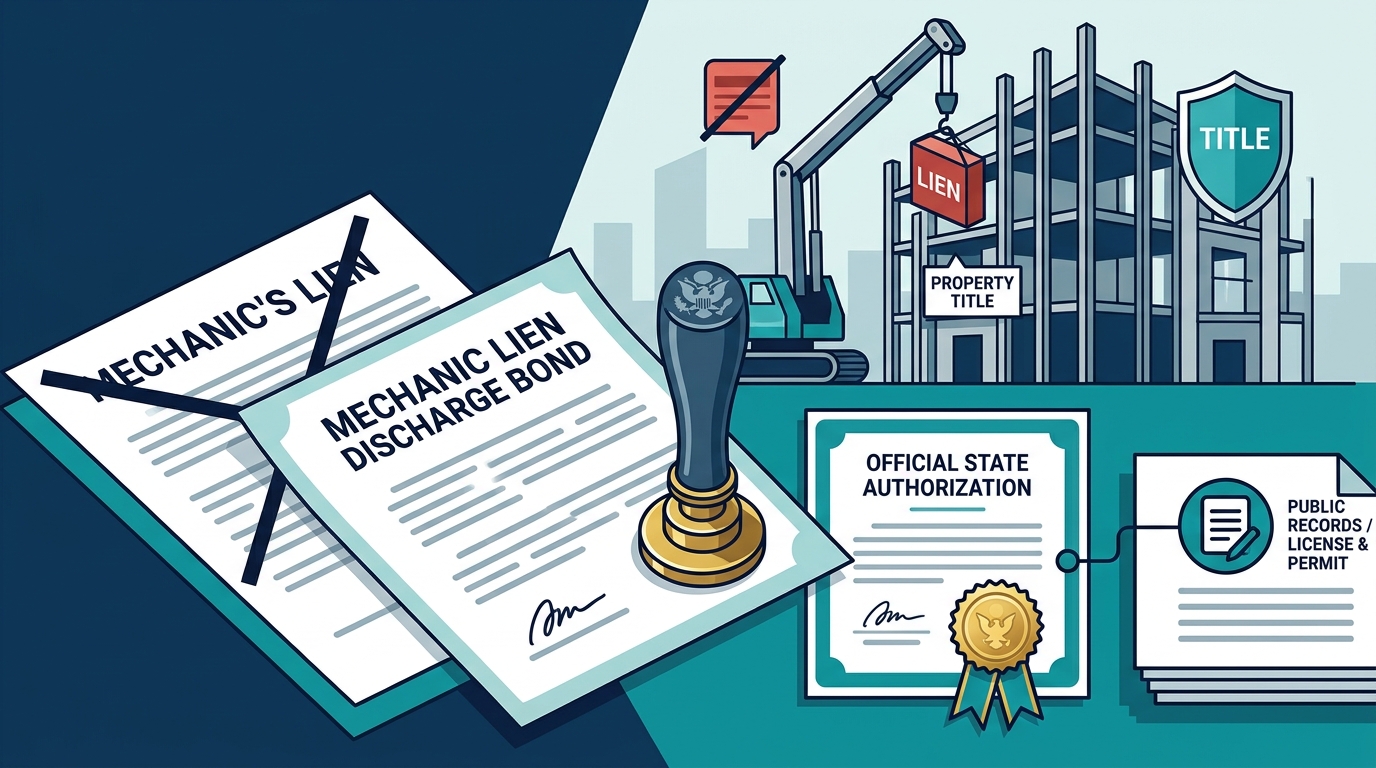
Only licensed surety companies authorized by state regulators can issue mechanic lien discharge bonds. These bonds allow property owners to remove a lien from their title while the underlying dispute is resolved. This guide explains the specific entities that issue these instruments, who purchases them, and the strict state authorization requirements that govern the process.
Surety Company Issuers
A mechanic lien discharge bond is a three-party instrument issued by a surety company. The surety acts as the guarantor, promising to pay the lienholder if the court determines the lien is valid. Unlike insurance, which transfers risk, a surety bond guarantees performance or financial responsibility. The entity issuing the bond must be a licensed surety underwriter.
Licensed Surety Underwriters
Only insurance companies that hold a specific surety license can issue these bonds. In the United States, surety companies are regulated at the state level. A surety company must be admitted in the state where the property is located to issue a bond for that property. This ensures the company has the financial backing to cover potential claims. Major national surety carriers and regional specialists both operate in this space.
The Role of the Principal
The surety company does not issue the bond in a vacuum. It issues the bond on behalf of the principal, who is the party requesting the lien discharge. The principal is typically the property owner. The surety evaluates the principal's financial stability and the merits of the lien claim before issuing the bond. This underwriting process is distinct from standard insurance underwriting because it focuses on the likelihood of the principal having to pay the claim.
Why Banks Do Not Issue These Bonds
It is a common misconception that banks or financial institutions issue mechanic lien discharge bonds. Banks may provide letters of credit, which can sometimes be used to bond over a lien, but they are not surety companies. A letter of credit is a payment guarantee, not a surety bond. Surety bonds involve a legal obligation to investigate and pay valid claims, whereas letters of credit are strictly financial instruments. Only licensed surety companies can issue the specific legal instrument known as a mechanic lien discharge bond.
Bond Purchasers
The purchaser of a mechanic lien discharge bond is the party who wants to remove the lien from the property title. This is almost always the property owner. The owner files the bond with the court or county recorder to discharge the lien. The bond protects the lienholder by ensuring they have a financial claim against the surety if the court rules in their favor.
Property Owners and Developers
Property owners, including residential homeowners and commercial developers, are the primary purchasers. When a contractor or supplier files a mechanic's lien, the owner's title is clouded. This makes it difficult to sell, refinance, or lease the property. By purchasing a discharge bond, the owner can clear the title while the dispute is litigated. The owner pays a premium to the surety company for this service.
General Contractors
In some cases, a general contractor may purchase a bond to discharge a lien filed by a subcontractor or supplier. This is less common but occurs when the GC wants to protect their own interest in the project or when the owner directs the GC to handle the lien. The GC becomes the principal on the bond, and the surety guarantees payment to the subcontractor if the claim is valid.
Why Owners Choose Bonds Over Cash
Owners often choose to bond over a lien rather than paying the claim in cash. Paying cash means admitting liability, which may not be appropriate if the owner believes the claim is invalid. Bonding allows the owner to maintain their position while protecting their title. The cost of the bond premium is typically a fraction of the lien amount, making it a cost-effective strategy for dispute resolution.
State Authorization Requirements
State authorization requirements for mechanic lien discharge bonds vary by jurisdiction. Each state has specific statutes that govern the process of bonding over a lien. These statutes dictate who can issue the bond, the required bond amount, and the procedure for filing.
State-Specific Statutes
Licensing and Admission
Surety companies must be licensed in the state where the bond is issued. This is known as state admission. A surety company that is not admitted in a state cannot issue bonds for property in that state. Some states allow non-admitted sureties to issue bonds under specific circumstances, but this is rare for mechanic lien discharge bonds. The surety company must also comply with state insurance regulations, including financial reporting and capital requirements.
Form and Content Requirements
States often have specific forms or content requirements for mechanic lien discharge bonds. The bond must include certain language, such as the names of the parties, the amount of the bond, and the conditions under which the surety is liable. The bond must also be signed by the principal and the surety. Some states require the bond to be notarized. The surety company must ensure the bond meets all state-specific form and content requirements to be valid.
| State | Required Bond Amount | Statutory Reference |
|---|---|---|
| California | 125% of lien claim | Civil Code Section 8424 |
| Arizona | 150% of lien demand | A.R.S. Section 33-1004 |
| Colorado | Varies by county | C.R.S. 38-22-131 |
| Connecticut | Set by court | Conn. Gen. Stat. Section 49-37 |
| Delaware | Claim amount or approved security | 25 Del. C. Section 2729 |
Key Takeaways
- Only licensed surety companies can issue mechanic lien discharge bonds.
- The bond purchaser is typically the property owner who wants to clear their title.
- Surety companies must be admitted in the state where the property is located.
- State statutes dictate the required bond amount and form.
- Bonding over a lien allows owners to maintain their position while protecting their title.
- The surety company evaluates the principal's financial stability before issuing the bond.
- Letters of credit are not the same as surety bonds and cannot be used interchangeably.
- Compliance with state-specific requirements is essential for a valid bond.
Frequently Asked Questions
Who can issue a mechanic lien discharge bond?
Only licensed surety companies authorized by state regulators can issue mechanic lien discharge bonds. These companies must be admitted in the state where the property is located.
Who purchases a mechanic lien discharge bond?
The purchaser is typically the property owner who wants to remove the lien from their title. In some cases, a general contractor may purchase the bond.
What is the difference between a surety bond and a letter of credit?
A surety bond is a three-party instrument that guarantees payment if a claim is valid. A letter of credit is a financial instrument that guarantees payment but does not involve the same legal obligations as a surety bond.
How much is a mechanic lien discharge bond?
The bond amount is typically a percentage of the lien claim, as specified by state statute. For example, in California, the bond must be 125 percent of the claim.
Do I need a lawyer to bond over a lien?
While it is not always legally required, it is highly recommended to consult with a lawyer when bonding over a lien. A lawyer can help you understand the legal implications and ensure the bond is filed correctly.
Can I use a bank to issue a mechanic lien discharge bond?
No, banks cannot issue mechanic lien discharge bonds. Only licensed surety companies can issue these bonds. Banks may provide letters of credit, but these are not the same as surety bonds.
What happens if the court rules in favor of the lienholder?
If the court rules in favor of the lienholder, the surety company pays the claim. The surety company may then seek reimbursement from the principal, who is the bond purchaser.
Conclusion
Understanding who issues mechanic lien discharge bonds is essential for property owners and contractors navigating lien disputes. Only licensed surety companies can issue these bonds, and they must be admitted in the state where the property is located. By working with a trusted provider like BLDAssure, you can ensure your bond is issued correctly and efficiently. BLDAssure offers comprehensive surety bond solutions, including mechanic lien discharge bonds, for contractors and property owners across the United States. To learn more about how BLDAssure can help you manage your construction risk, visit our about page or explore our services.